Friday, February 5, 2016

Mateus

Mateus was my neighbor.  He was 13 years old.  He was epileptic.  He was epileptic in a small town in rural Mozambique.

Mateus had seizures every day of his life.  They were bad, and due to his preference for wandering around town, they were often in public places.  Naturally, our other neighbors decided that he was possessed (by demons) and each time he had a seizure near people, they would beat him/the demons.

The first time I met Mateus, he had come to my house to ask for a knife.  Because I didn't know Portuguese very well at this point, I was very confused, even more so when a neighbor came out of her house and started doing the finger-circling close the the temple sign for "crazy."  Since I didn't understand him, nor did I want to hand over a knife to a child who may or may not have been mentally stable, I apologetically set him away.

My neighbor then ran up: "Mana Ana, he's crazy.  That's what I was trying to tell you.  He shouldn't be at your house."  Okay, I thought.  But he's just a kid.  What's the deal?

I saw him around more after that and always said hello to him, noticing that others rarely did the same.  As my friendships grew, I asked people I began to trust about his situation.  They explained: He has seizures and doesn't play with the other kids.  No one knew how old he was.

When I asked him how he was, he would always give me a discombobulated answer about someone beating him, usually to my understanding, his family.  I always saw him wandering around at night, smelling strongly of pee, adding more to the image I had of the neglected/abused child.

The next step in the investigation was to talk to the nuns, who, although removed from the fofoca train (gossip), would probably have some idea.  The nun who worked at the health post explained to me that his father was gone, his mother had died from AIDS, and he lived with his great aunt.  I asked if he was HIV positive, thinking that if he were, we may be able to send him to live in a group home for HIV positive AIDS orphans (there are a few of those in Mozambique).  This nun, to whom I will forever be grateful, took him for an HIV test. He was HIV negative.

I spoke to other friends, and was directed in a very indirect way to the social services director in Gurue.  I explained the situation, and he immediately sent someone to the family with clothing detergent, rice, soap, and other basics.  Throughout the next year, I worked with him to try to find a place we could send him to get better.   No one would take him with untreated epilepsy.

About 10 months into that year, completely discouraged and very disillusioned with the pace of social services in Mozambique, my tea field confidante asked me a very pointed question.  Would he be better off somewhere else?

As I began to actually look at the situation after having lived there long enough to understand things I hadn't before, I began to see that the entire village took care of him.  They gave Mateus food, juice, bread, and sometimes coins.  When it was dark, they told him to go home.  So maybe it shouldn't be so automatic to take him out of where he knows.  His family would have no resources to care for him anywhere but the village, and I hadn't even met the majority of his extended family.

As I was leaving, I met the neighborhood boss (chefe do bairro), a man who sells dried fish in the market and knows everyone.  The conversation turned more to treating the epilepsy than taking him away.  He thought this the better course of action - and then I had to leave.

When I was sent back to Gurue with TechnoServe, I learned that there was an uncle who gave him baths when he needed it.  And that many of his injuries happened not because of abuse, but because he would have seizures in the middle of the road and fall down with no one to catch him.  I learned just how poor his family was, and how much of what I had perceived as malice was actually an inability to change pretty horrific circumstances.  I learned that he had started to read books with the new Peace Corps Volunteers and I saw him laugh and smile for the first time and many times after that.  When he had seizures near the Peace Corps Volunteers' house, they made him as comfortable as possible to avoid injury.  I contacted the neighborhood leader again and we managed to get him an appointment with the psychologist in Gurue who treats epilepsy.  The boss arranged for a family member to accompany him, and the driver for our project (the same as my invinha confidante) drove us for his first appointment.  He was accompanied by an uncle who also suffered from epilepsy, although his was much less severe.  They were both given medication and sent home.  At their two-week follow up visit, I met them at the hospital and we went to talk to the doctor about the medications.  Neither Mateus nor his uncle had had a seizure since starting the medication.

A week later, during a beach weekend during my last few days in Mozambique, the neighborhood boss called me.  Mateus drowned, he said.  He was in the river and fainted.

I sent the family 200 meticais (about $8) in order to help with burial costs.  I wasn't able to go because I was so far away and the burial was to be the next morning (no way to preserve the body).

I am grateful to have started a friendship with the neighborhood leader, by far the most competent administrator I have met in my 3+ years in Mozambique.   I am grateful to the nun who continues to be of service to all those in need and who is a rare example of who a nun should be in a world of common corruption.  I am grateful to have met the social services bureaucrat, who taught me that corruption and a good heart are not mutually exclusive.

 I am grateful his uncle now knows how to get help and free medication for the other epilepsy sufferers in their family.  I couldn't have done any of this without the help of a small group of stellar Mozambicans.

 I am grateful because I knew Mateus.  I am grateful to have met his family, and to have seen the way his uncle cared for him and the way his uncle smiled every time Mateus asked for juice and cookies (he asked all the time).   I am grateful that Mateus died before he had another seizure in public necessitating a demon exorcism (beating).  I am grateful that he died during the best year of his life, and that he died knowing how it feels to have people care about your situation and knowing how it feels to not be completely alone.

Mozambicans usually have two names.  One, they use publicly, the other, they use at home.  At home, Mateus was called Segredo (Secret); his story need not be one too.

Mateus Manuel

Thursday, November 12, 2015

mozamechanic

the project car got a flat tire this week. we paid 150 meticais to change the tire and fix the flat one. that is $3.57.

Thursday, October 29, 2015

Peace Corps Home

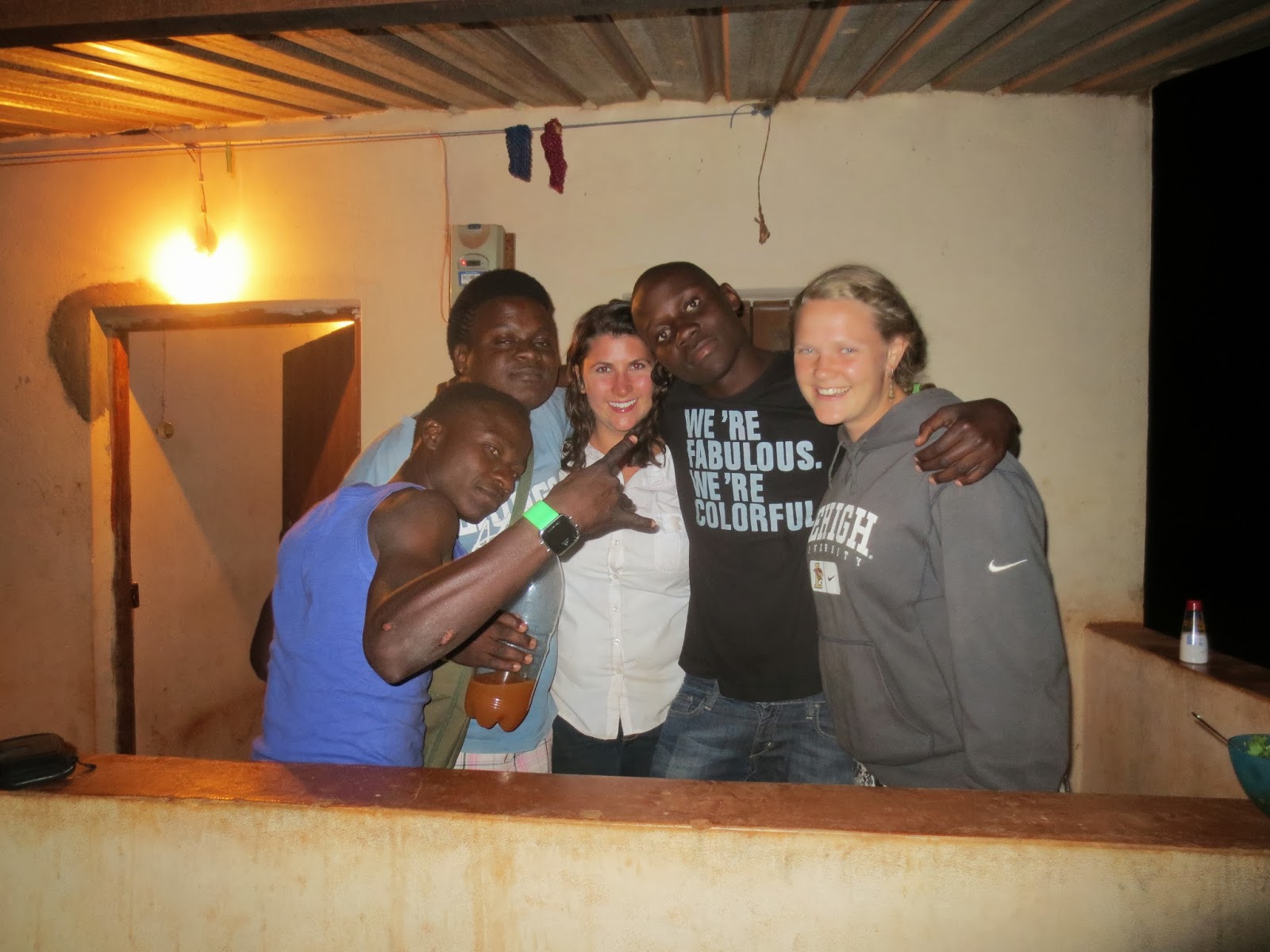
The volunteers who live in my old house are now preparing to leave.  They are both going back to the United States and had a goodbye party yesterday.  I went for a bit - obviously giving them their space to say goodbye to our mutual friends and community.

As soon as I got there I found this project beneficiary with his tablet and his friends!  I have to do a lot of encouraging and technical support, but the format of the project was thought of with the context of the local culture in mind.  It's very cool to see something working with relatively little foreign intervention.


It's a weird feeling.  I've already said goodbye, but I'm back.  This time, because the goodbye feels more permanent...it's harder.  There is no way to keep in touch with the majority of my students, and the neighbor kids aren't old enough for cell phones.  Even for my students and friends who have cell phones - robbery is common, many live without electricity (therefore not having a phone that's turned on very much) and they lend phones to other people all the time (so when I call, sometimes I talk to someone I don't know).  Leaving is going to smash my heart into a million little pieces, but I keep having to remind myself that it is time to go.  My wise aunt Janet and I were talking about being of public service while I was at home and she had a very good point for mental health: it's important to do things for fun, to do things that aren't in the service of those you are helping.  Go swimming, not to teach anyone to swim, just to hang out in the water.  Go out to dinner - not to start a new project, not to fix current issues, just to have a pizza (and beer).  It's time for me to do that - but it doesn't mean that I wont miss the mountains every day.


Thursday, October 15, 2015

It's October?!

Yes, it's October.  After a whirlwind trip back home to see my brother get married (Success!) and a week waiting around New York for the Mozambureaucracy to get its act together (with a brief and lovely encounter with Amtrak, Philadelphia, and my grandparents), I got back to Mozambique with just enough time to...sit around? Since I'm still working on transportation I've been more or less stuck in Gurue.

I'm still battling to get a car for the project (definitely making progress) and in the last week, I've managed to put grates on my new house (pictures forthcoming), install new locks (when the house sitter lost all of the old ones), hire a wonderful woman to wash my clothes (because it is really no fun to hand wash jeans), get a contract for a new project driver, almost get my company to pay back salary to the previous driver, and eat a lot of wonderful mountain samosas.

It's been quite an African week and in order to be completely honest (because the internet needs more honesty) I am very proud of myself (and grateful to all of the moral supporters and africa magic intervention that helped make all of the above happen in a week of being back.

In the next few weeks, there will be beneficiary training, maybe a business trip or two, and more pictures!

Thank you to everyone who made my stay in the United States such a success!

Thursday, August 6, 2015

Cecil the Lion

The news of Cecil the Lion's passing has indeed reached me in Mozambique (through American media outlets, of course).  This article explores the typical African response very well. (And mine too, maybe I've been here too long)

http://www.nytimes.com/2015/08/05/opinion/in-zimbabwe-we-dont-cry-for-lions.html?mabReward=A5&action=click&pgtype=Homepage&region=CColumn&module=Recommendation&src=rechp&WT.nav=RecEngine&_r=0

Friday, July 17, 2015

Theft

I had a long, complicated blog post all set up to post and then...

I read something on another blog: theft is actually wealth redistribution.  So you will get a slightly shorter, slightly more direct post.

As communist as that statement sounds/is, it was an interesting thought for me - my house was broken into during my first year in Peace Corps, dozens of other little things were stolen throughout the 2 years, and I said goodbye to Invinha by realizing that the student who had been helping me with house stuff for a year (and getting paid, given food, and was told he was allowed to ask for what he wanted but couldn't just take it) had been stealing things big and small for awhile.

I won't say much more - although I think in the purest form, theft is forced wealth redistribution.  Not that it is fair, not that it creates a nice ambiance in which to live - but the students who broke into my house and took everything from an electric iron to laptops were definitely much poorer than I am or ever will be.  The positive?  Maybe they took those things and made a better life for themselves.  Probably not, because they're teenagers with an underdeveloped frontal lobe, but maybe.  The negative?  It was the only time I seriously considered quitting Peace Corps and I completely lost trust in everyone in my community and only got it back for a special few. I try to offer things when I can and be perceptive to need  - generosity is the only thing I have come up with to deter theft.  It didn't work out very well with my student, but it might in the future. For a change, I'm not offering a solution.  I don't have one.


Anyway, what do you think?  Is there a moral certainty regarding theft?  Is it always wrong?

Me, a tin roof, and my trusty almost thief proof purse.


Friday, July 10, 2015

The Catch-22 of INGOs

I will first qualify this post.  I am a young development worker, which is to say, I'm not very old or experienced.  I have professionally worked for longer than 6 months in one country - which is to say, not very long.

Mozambique has been called a "Foreign Aid Darling" in recent publications, and this moniker does indeed represent a lot of money being thrown to Mozambique in the name of projects.  It's seen everywhere - the big pagoda-shaped resort being built in Maputo by the Chinese, the number of Mozambicans who say "Oh yes, I know a lot of Germans and Danes" and as I'm told, most notably the increase in the number of foreigners both in grocery stores and the offices of Immigration.  

This represents money.  Lots of Money.  And as far as for-profit companies go, it's understandable.  Come to a new, rapidly growing market, make a profit, employ more people, continue profiting.  It's how the system works.  In terms of International Non-Governmental Organizations (INGOs), this gets more complicated.  They have a mission to "help people."  The problem is this:  how can you help people if you don't know what they need?  There is so much infrastructure in international development attempting to help well-meaning INGOs figure out what the local population actually needs.  I'm not convinced this works though.  I've seen how much reports can be manipulated without ever actually telling a lie.  

These INGOs are rich.  They've been in Mozambique for anywhere from months to decades, and continue with noble mission statements and dedicated staff.  The problem is this: their programs are good.  Mostly worthy of the billions of dollars in funding received.   But not good enough to put themselves out of business (sustainability).  

In a recent conversation with a new colleague, a Mozambican who has spent decades working with everyone who is anyone in the foreign aid business in Mozambique, he clearly laid out the culture of dependency created by these programs.  Farmers had unions.  Then big organizations came in with projects that treated the farmers as babies.  Farmers became dependent on these organizations for money, infrastructure, and ideas, and he we are, decades later, waiting for them to become independent as they are waiting for us to come up with the next idea and pot of money.  

Does this mean that the world would be better without the programs?  I'm not sure yet, to be honest.  I think there are good and bad programs, competent and not competent people, good and bad ideas.  Looking back at my older posts, I think the main problem is this: it's not that we can't build good programs.  It's not that we shouldn't not try to help people because of this fear of dependency.  It's that there is a history and structure bigger than any one program, any one person, and I'm starting to think that we got most of that part wrong.  

HOWEVER.  Mozambique has seen record development since the civil war ended.  So just because a system is wrong or not perfect doesn't mean that it doesn't achieve.  It's complicated.

Things have gotten better for this family.

Tuesday, July 7, 2015

The Traveling Hannah

I'm back!  And, with the orders of Fred Kyle, about to be much better about my blog posting.

I have moved from program manager of a library (www.livroaberto.org) to program manager of a short term project.  I'm in Maputo for about a week to get everything we can set, and then I go back to the city in the tea fields.

The flight over was as fun as most 15 hour flights are, meaning that I watched a lot of movies, was blessed to sleep a solid 4 hours, and was very happy when we touched down in Johannesburg.

Johannesburg happened so that I could meet with the South African team who is implementing the same project in South Africa that we are in Mozambique.  The meetings were really helpful and it was absolutely the coolest experience of my embryonic life as a development worker to be in a meeting about development in Africa as the sole non-African. 

After 2 days wandering around the chic neighborhood where I stayed for my first business trip, Rosebank, Johannesburg, I took a quick 45 minute flight and I was in Mozambique!  My Blackberry worked immediately, meaning it really was as if I had never left.  However wonderful it is to have 21st century technology on your side, the best thing about returning to Mozambique has been realizing how wonderful the 2 months at home were.  I was nervous about going home the first time - it had been a long time since I had been home, it had been even longer since I had stayed with parents for more than the length of a vacation, and I was jumping into the depths of possible unemployment and a bank account ruined by Mozambican immigration fees.  At the same time, I went home because I wasn't happy in Mozambique anymore, and it truly didn't have anything to do with Mozambique.  I just wasn't happy.  It was time to go home.   Right about as my Blackberry powered up, I felt content.   Happy to be back, happier to have been home, and yes, already missing all of my family, friends, and American steak (the Portuguese and Mozambicans both have their versions and it just isn't the same).

As I type this, I'm sitting in the offices in Maputo.  A driver comes to get me every morning to bring me to work (this will only happen while I'm in Maputo, my project is based in the tea field and the city where I will live is not big enough to have any public transportation and therefore no need for a private driver), I enter a building and take an elevator (!) to go to an office where they have graciously given me desk space.  The project is intimidating because so much depends on how Mozambique does along with the other countries participating, but I'm slowly getting a better understanding of the task and thoroughly enjoying the human resources employees who are taking care of my visa, renewals, and work authorization.

So far so good.  I also just realized I didn't take any pictures while home, and I don't have any yet from this trip.  So, pictures from the end of the last Mozambique tour:

In my favorite city (Beira), cooking my favorite Mozambican food (Cassava leaves with coconut milk and peanut flour and in this case, shrimp)

She almost didn't let me go to the airport.  I almost let her let me not go to the airport.


Inside the classroom where they called me teacher

At the high school where they called me teacher


Sunday, February 8, 2015

I live in a city?!

And so, I have missed yet another month. I have a good reason. I swear.  "Settling in..."

Maputo is different.  My first week here all I could tell people was that Maputo is so cool because it has dental floss in the grocery stores.  And MOUTHWASH.  what?

I can't lie and say that the novelty has completely worn off.  I still can't believe the food variety available (and often make exactly what I made in the tea field because I don't know what else to do), I still wander around big grocery stores slightly lost (the little ones are more manageable), and I still can't quite believe how Maputo relates to the rest of the country.

It is the capital city.  There is opportunity - many different schools, medical clinics, business opportunities.  One of the problems of rural poverty is proximity to the rich - where I was, there weren't any rich people to speak of, and so business was hard.  How do you sell to people who don't have money?  Things worked out - my village is able to support a few local stores and every once in awhile people come with new goods.  In the city - there will always be rich people buying bottled water, which means there will always be bottles for poor people to sell.  As stifled as an opportunity as this may seem, it is a lifeline.  Although I am privileged, I have seen far too much what lack of opportunity, any opportunity, can do to someone.

Maputo feels untouchable.  There was flooding in the beginning of January (an understatement, I believe it was the worst in 44 years) in my home province.  Electricity is still out, and the biggest bridge in the province connecting north to south is still broken.  But my (hot) running water has stayed on, my electricity has not gone off once, and food/transportation prices remain the same.  I don't wish I were still living there - being witness to such destruction and desperation isn't fun, nor do I wish misfortune on anyone - it makes me uncomfortable that the leaders of the country do not feel the suffering as everyone else does.  Maputo is of its own.

And to make matters worse (or just different?), this is really the first time I've ever lived in a city for longer than a few months.  To be honest - I'm having many conflicting feelings, but it is pretty great to be able to order takeout (for the first time in my life), call taxis to take me places and catch buses (because I live inside the city limits!), and live in a city that has zones where people don't stare at me ALL THE TIME.  Even after 2 years living in the same small town, there were people who stared at me while I did all of my food shopping. Or just walked around.  I did visit a friend today in a neighborhood today that was exactly like being back in Peace Corps.  You can just read people's expressions: "Is this girl lost?"

There is so much more to say, but I definitely need to organize my thoughts before I ramble past the point of no return.  Maybe next time I'll post about my job?

The group with our big boss, Custodio - saying goodbye (and of course my ultimate Maputo welcome)

Sunday, December 28, 2014

Back to the Future


So in the time between my musings on the world and now, I've finished my Peace Corps stint and traveled to our amazing capital.  I say amazing because that's exactly what it is: banks on (almost) every corner, dental floss and sometimes ziploc bags in the grocery stores (yes, there are grocery stores), and business hours that are more or less followed.

In light of all of these wonderful things, I will be staying a bit longer here, working for an NGO as their project coordinator (in light of various security things I will send out specifics via email if you're interested).  I haven't completely decided the fate of this blog -  part of it depends on what I have to say (as life becomes less of a novelty and more familiar to those at home because I'm in a city) and part of it depends on you (aka demand).  To be determined, I guess.

For now: I'm renting a room in a house with a beautiful yard etc that's in a nice neighborhood and celebrating/waiting to go back to work in the new year.

Merry Christmas, Happy Holidays, and Happy New Year!


Monday, October 27, 2014

Os Senhores Manuel e o mundo


Partly because I am tired of proctoring written tests, partly because I am tired of grading, partly because I didn’t want to cater to more students who didn’t come to class when we had the test and “NEED” a make-up exam, and partly because of my most recent lunch date, the make-up “exam” we had for my 11th grade computer and technology class was a graded debate.  The question being debated was “How can we better the world?”

After they finished being amazed and confused about such an open-ended question -
“But teacher, better the world in what terms?” “There really is no right answer?” Their answers to this question varied – caring for the environment so agriculture has a future, better educated farmers, building more vocational schools and giving more access to students to these vocational schools, bettering the training of doctors, building more hospitals, and creating more scholarships (that could be fairly won) for students to study at all levels.

These are all very good answers – it is obvious to me that despite the challenges that each one of my students face in getting enough food, studying (and passing if not able to pay the “tax”), caring of family members, etc., that they have really thought about what they would change if they could, and what they hope will change for Mozambique in the future.

I focused the conversation after that discussion on my lunch date with Manuel.  Selfishly, I was looking for hope and answers.  But I also wanted them to think about how they can help people like Manuel now.

The students said it is important to give money if you have it to give.  They said it is important to treat them as people (Podemos conviver com eles).  They said it is important educate others who might be afraid of strange behaviors or possible illness. 

A side to this I had not thought of (I haven’t gone native quite yet, obviously) is that sometimes people like Manuel are victims of “feitiçaria” or witchcraft.  All students present quickly agreed that this is a possibility, but I was happy to hear that they didn’t think that they couldn’t help someone afflicted by such magic.  They said the same things hold true, even if someone has been cursed.  Give them money. Give them food.  Give them friendship. 

Monday, October 6, 2014

O Senhor Manuel

Our quarterly report for Peace Corps asks us to share a success story.  Maybe it's because I'm about to become a Returned Peace Corps Volunteer, or maybe it's because Manuel made an impression on me.  In any case, I couldn't justify writing about another student of mine who has gained confidence because of Peace Corps programming (though they exist in full), nor could I write about how PEPFAR's money is being put to good use (even though most of the expenditures make sense).

This is Hannah's "Success Story" for the reporting period April 2014 - September 30, 2014.

The most meaningful story I have at the moment is not a success story.   It is a reflection into a very complicated situation and the perspective gained only through the process of leaving a place.

I was in Gurue, a small city near my house.  As I was walking to my favorite take-away restaurant, I noticed a very thin man who looked ill.  I said hello, but continued into the restaurant.  After I ordered, the man also entered the restaurant.  He stood in the middle of the room, and looked very confused.  I asked him if he was hungry, and he said yes.  The restaurant owner then gave him a meat pastry, and I bought an egg sandwich.  When I turned around, the man was huddled in the corner eating the pastry the owner had given him.  I asked him why he wasn't sitting at the table - his reply: "I don't have money to sit."  I told him that he doesn't need money - only food. I invited him to sit at the empty table or at my table, where I was sitting alone.  He chose to sit with me, and I shared my lunch with him.  From there, we started to talk.  His name is Manuel, and he used to live far in the country.  He came to Gurue awhile ago, but doesn't have anywhere to sleep.  He often sleeps in the forests around Gurue, and works when he can.  Parts of this story came out slightly convoluted, and so it was impossible to determine if he was suffering from mental illness, malnutrition, hunger, other illness, or most likely, a combination of everything.  I told him parts of my story too, but I mostly just listened.  We parted ways with "Até a próxima" or "Until the next."

I do not consider this a success story because humankind and the very systems we have created to help people like Manuel have failed him.  He was reduced to standing, waiting for someone to notice him, to give him food.  Something had happened to him so that he no longer even asked for food.  So often, our reports ask to share success stories.  While our work has many successes, and that is why we stay here and enjoy what we do, there are so many failures that we see, and these failures will not be fixed by the status quo.  The hegemony of international development has done much good, but has also failed more times than we, as a community, can count.  Peace Corps Volunteers are in a unique place to bear witness to these great successes and great failures.  It is part of our job to report these failures, understanding as we have  come to that our reports of successes and failures in our community will not be put in the next USAID agency-wide memo, nor will these reports necessarily help to better the bigger system that centuries of humans have created.  It is not helpful to report one more child who has gained confidence because of a Peace Corps Volunteer.  For this child, the volunteer has changed his/her life.  But for reporting purposes, we already know that children become empowered through our program.  What we don't know, in scientific terms anyway, are the circumstances of the people that every program fails to reach and how we can better design a program for the "unreached."  We will not be doing our part as humans, nor as development (semi) professionals if we continue to focus only on our numerous successes.  It is important to remember that Manuel, a person who probably had very bad luck, and may never had even had a chance at a different life, is not the only person in the group of people for whom these programs make no difference.  These systems are big enough, our collective brains powerful enough, that we should not accept their suffering.  Although we may not be able to eliminate it, we have to try.

Monday, July 28, 2014

Travels of a Tshirt in the Free Economy

Aside from the title of this post, "Travels of a Tshirt in the Free Economy" is the book Carleton College made/asked the class of 2012 to read before freshmen orientation.  Like any good pre-college student, I read it - its central thesis being: it takes a global economy to make a tshirt these days.  From cotton in Texas, to a factory in China, to Goodwill in New York City, to a ship crossing the Atlantic, to a second-hand clothing market in Africa.  Well, I can say definitively, I have found the tshirts.

I have said a few times that Africa is where clothes come to die.  While this may not be completely true, it is completely true in my experience.  Exposed wood, broken metal, and vigorous hand washing all make for tears.  This means that since arriving almost 2 years ago (!) I have had to buy new clothes.  And this is more or less the clothing industry:  

A clothing auction (note the USAID relief tarp being used for something other than its original intended purpose)

A tailor
the cheapest clothes (5-15 meticais, 31 meticais to the dollar) come in piles

Clothes and Shoes

This is Gurue's version of the Salvation Army.  They get new shipments every month, and I get most of my clothes here.


I am missing a picture of the stores that sell new clothes.   These are often directly from China or Brazil and are definitely out of a Peace Corps Volunteer's budget.  Pants - $20, shirts $18-$25...the list goes on.


Sunday, April 6, 2014

The (almost) Daily Bucket Bath


 First, this post is dedicated to Fred and Elena Kyle in Philadelphia, Pennsylvania.  They both enthusiastically responded to my recent surge in posting and in the case of Fred, implied doubt that this trend would continue.  Grandma and Grandpa, this one's for you.
Oh, and I should also probably dedicate this post to those who originally taught me how to take a bath.  Mom and Dad, this one is also for you.

Really, learning to bathe oneself in an entirely new way at any age after 15 is quite an accomplishment.  And now, a year and a few months into practicing the new art of initially changing my bathing technique at age 22, I am ready to report.

Step 1: Heat up water (if it’s cold outside).  If you are already dripping in sweat, skip this step.  You may also skip this step if you are one of the people who subscribe to the “banho frio faz bem” theory.

Step 2: Carefully mix hot water (if applicable) and cold water in the big plastic bucket to make the perfect body washing temperature.  This “perfect temperature” is completely subjective and what is your perfect body washing temperature is not necessarily someone else’s.  Be careful not to spill the boiling water on you before mixing.  This is said from personal experience.

Step 3: Place the plastic bucket in the designated “shower area.” Follow said bucket so you are also standing in the designated area.

Step 4: Take a smaller container (Plastic butter containers, for example) and start scooping water from the bigger bucket and pouring it on yourself.

*This is where it gets very personal and individual.  Although a few of the host families in the very beginning tried to bathe the volunteer, I have decided that because I am writing this guide for those who have already mastered one bathing technique, I will leave the rest up to the reader.  I will say: although soap is used in Mozambique if the family has it (most of the time), I highly recommend that you have soap on hand.

Sunday, March 30, 2014

Photo Update!

These are the kids who welcome me home from every trip (whether its to the big city, the small city, work, the market)  They are all dressed for a birthday party, and came to my house to tell me I needed to take a bath and come to the party too.

Neighbor with the birthday boy

The first cohort of Livro Aberto/Peace Corps/USAID library volunteers!

Mandioca/Cassava and Dino!

Mozambican party food (chicken was also present)

My favorite map at my favorite pizza restaurant in the provincial capital.

For Christmas, I found the beach.

They were demonstrating how they know how to carry things on their heads.

Mozambique Talks

What does Mozambique tell Hannah?


Your breath smells bad if you eat hot food.
Michael Jackson is alive.
Michael Jackson is probably living in Brazil.
Michael Jackson is Mexican.
Dust ruins everything.
I will marry you.
You will marry me.
You need to marry in Mozambique.  I will find you a man.
You left your husband and child(ren) at home?
You are Italian, yes?
You are Spanish, yes?
You are Portuguese, yes?
You are Brazilian, yes?
You are from Maputo?
Take me back to wherever you are from.
I’m not sure Osama Bin Laden is dead.
Something really bad will happen if you don’t take a bath before dinner.
I am planning to have 2 or 3 wives.  This is a good number.
Do you have onions and oil? I want to make an onion salad.
There’s a potion you can put around your house that makes would-be thieves freeze like Medusa’s victims for you to find them and exact punishment later.
The United States has at least one person in every country to control what happens in that country.
If you’re pregnant, you can’t eat eggs.
North America is cold.
Spanish is badly spoken Portuguese.
Sitting provokes thoughts.
Quiet people are troublemakers.
You should move nationality – Mozambique would let you be Mozambican, yes?
You need to learn to like Mozambican music.
White women with cars steal children to sell their organs in Malawi.

Happy (Almost) April!

Sunday, March 23, 2014

Theee Yankees Win!


This project came about because I was seeing many yankees outfits around the mountains, and I thought that in addition to documenting this stellar Mozambican baseball preference, I should share it with the yankees I know stateside.  Unfortunately, my camera was only with me on these 5 occasions, but I have also come across 3 yankees shirts, 1 yankees jersey, 7 other yankees baseball hats (1 neon yellow), 5 yankees winter hats, and 1 yankees jacket.

Viva os yankees!


*Also trying to explain to everyone why I wanted these pictures was, actually, a profound intercultural experience.

Wednesday, December 4, 2013

Hannah, 14(ish) Months In

Our frog friend on our door grates. He/she had really cool red legs.


This Hannah often eats rocks, mixed in with the beans or rice or bread. (or sand or dirt or ants)
This Hannah often thinks she’s tan, but it’s really just the dust that comes from living far away from any cement infrastructure. 
This Hannah often trips over rocks embedded in the dirt road. Or falls in the holes in the really old “sidewalk” in the nearest city.  And subsequently…
This Hannah often gets laughed at by large groups of people.
This Hannah often does laundry, sometimes just to get the very stubborn dirt/dust combo out from under her nails. 
This Hannah often needs new clothes because Africa is where clothes come to die.  When buying these new clothes…
This Hannah often thinks that over $4 for any item of clothing is expensive and rethinks the purchase.
This Hannah often deludes herself into thinking that a hot bucket bath is as good as a hot shower.
 

So. These are some things that the Mozambican version of myself does.  Only time (and a triumphant return to the homeland) will tell if I will continue to eat rocks, be tan, and trip (okay I will definitely keep tripping over things).

Saturday, October 5, 2013

AND WE'RE BACK.

Neighbor and Counterpart Benvindo (eyes closed, but fazer o que)
Rainy Season

Our very informal pre-school (this is our porch)

Sometimes we get student visitors (mostly when the school decides to have a big party)

Ilha de Mocambique.  Lots of Portuguese architecture, lots of post-apocalyptic Lisbon feeling